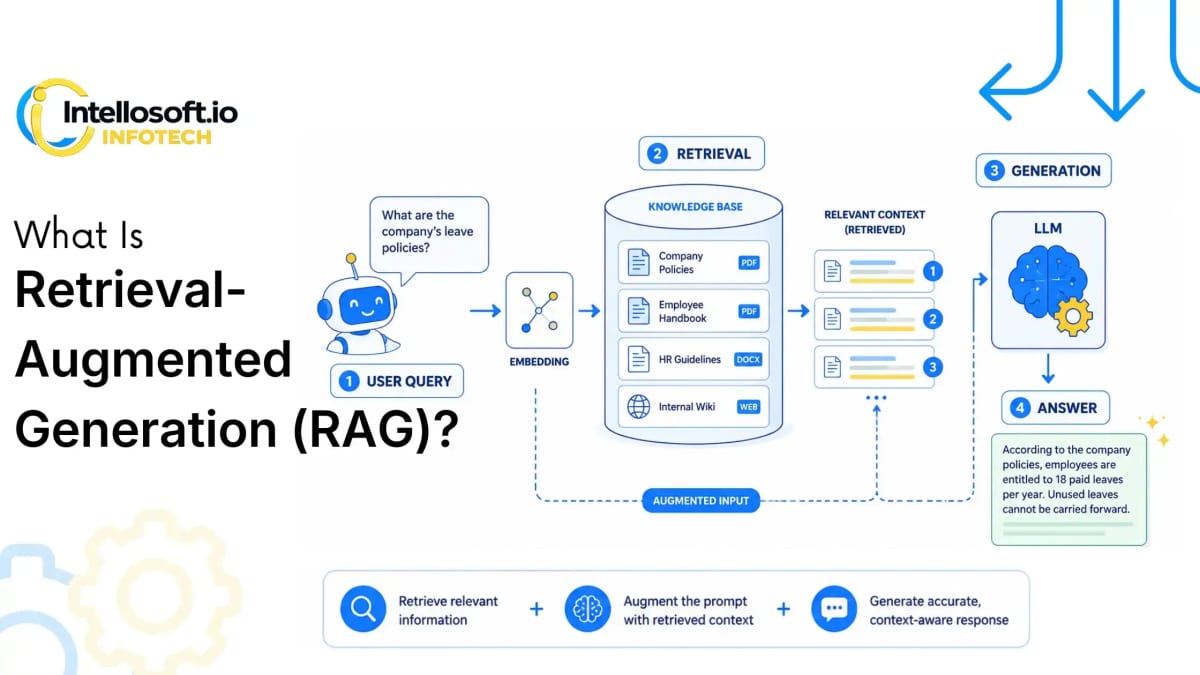
Retrieval-Augmented Generation (RAG) is an AI architecture that enhances Large Language Models (LLMs) by retrieving relevant information from external knowledge sources before generating a response. This approach reduces AI hallucinations, improves factual accuracy, enables access to private enterprise data, and keeps AI responses up to date without retraining the model.
Artificial Intelligence has evolved rapidly over the past few years, but one challenge continues to affect even the most advanced LLMs: they can generate inaccurate, outdated, or fabricated information, commonly known as AI hallucinations.
This is where Retrieval-Augmented Generation (RAG) changes the game.
A RAG system combines the reasoning capabilities of an LLM with real-time information retrieval from trusted data sources. Instead of relying solely on the knowledge stored during training, a RAG system searches relevant documents, databases, or knowledge bases before generating a response. The result is significantly more accurate, context-aware, and trustworthy AI.
Whether you are building an AI-powered customer support chatbot, an enterprise knowledge assistant, or an intelligent document search platform, RAG has become the preferred architecture for deploying production-ready AI applications.
If you are exploring enterprise AI solutions, our AI Development Services can help you build secure, scalable, and production-ready RAG applications.
You may also be interested in our guide on Model Context Protocol (MCP) to understand how AI systems securely connect with external tools and data.
According to Gartner, by 2027, over 60% of enterprise generative AI applications are expected to use retrieval-based architectures to improve accuracy and governance. Enterprise AI benchmarks consistently show that grounding LLM responses with retrieved documents reduces hallucinations and improves answer relevance in domain-specific applications.
Why Traditional Large Language Models Need RAG
Large Language Models such as ChatGPT, Claude, and Gemini are trained on massive datasets. While they excel at language understanding, they have several limitations.
1. Outdated Knowledge
An LLM only knows what it was trained on. It cannot automatically access your latest company policies, newly published research, or recently updated product documentation unless it is connected to external knowledge. This is why businesses pursuing AI development services increasingly adopt retrieval-based architectures.
2. AI Hallucinations
One of the biggest concerns with generative AI is hallucination. The model may confidently produce incorrect answers when relevant information is not available. RAG significantly reduces hallucinations by retrieving verified information before generating responses.
3. No Access to Private Enterprise Data
Your organization likely stores valuable information in internal documents, PDFs, SharePoint, Google Drive, Confluence, CRM systems, knowledge bases, and SQL databases. Traditional LLMs cannot access these resources by default. RAG bridges this gap by retrieving relevant content from enterprise data sources in real time. Many organizations combine RAG with cloud infrastructure services to securely store and manage their proprietary data.
4. Expensive Fine-Tuning
Many organizations assume they need to fine-tune an LLM whenever their business data changes. However, fine-tuning is often expensive, time-consuming, and difficult to maintain. With RAG, you simply update the knowledge base, and the AI can immediately retrieve the latest information—no retraining required.
How Does Retrieval-Augmented Generation Work?
At a high level, a RAG system follows six essential steps.
Step 1: Collect Enterprise Data
The first step is gathering information from various business sources, including PDFs, Word documents, websites, product manuals, customer support articles, internal wikis, databases, and APIs. This creates a centralized knowledge repository. For organizations managing large-scale data, leveraging cloud infrastructure services ensures scalable and secure document storage.
Step 2: Split Documents into Chunks
Instead of storing an entire document as one block, it is divided into smaller sections called chunks. Chunking improves retrieval accuracy because the AI searches smaller, highly relevant pieces of information instead of lengthy documents. A good chunking strategy is one of the most important factors affecting RAG performance.
Step 3: Generate Vector Embeddings
Each chunk is converted into a numerical representation called an embedding using an embedding model. Embeddings capture the semantic meaning of text rather than relying on exact keyword matching. For example, “How can I reset my password?” and “I forgot my login credentials” have different wording but similar meanings. Embeddings allow the system to recognize this similarity.
Learn more about embeddings and semantic search in the official OpenAI documentation.
Step 4: Store Embeddings in a Vector Database
Once embeddings are generated, they are stored in a specialized vector database optimized for similarity search. Popular vector databases include Pinecone, Weaviate, Milvus, FAISS, and Chroma. Unlike traditional SQL databases, vector databases search by meaning rather than exact text matches, making them ideal for AI-powered retrieval.
Step 5: Retrieve the Most Relevant Information
When a user submits a question, the system converts the query into an embedding and searches the vector database for the most relevant chunks. Instead of searching millions of words, it retrieves only the most contextually relevant passages. This dramatically improves answer quality.
Step 6: Generate the Final AI Response
Finally, the retrieved context is sent to the LLM along with the user's question. Instead of relying only on its training data, the model now answers using the retrieved documents, making responses more accurate, better grounded in facts, up to date, context-aware, and less prone to hallucinations.
RAG Architecture Explained
A typical Retrieval-Augmented Generation architecture consists of the following components:
| Component | Purpose |
|---|---|
| Knowledge Base | Stores enterprise documents and data |
| Document Loader | Imports files from multiple sources |
| Chunking Engine | Breaks content into smaller sections |
| Embedding Model | Converts text into vectors |
| Vector Database | Stores vector embeddings |
| Retriever | Finds the most relevant information |
| Prompt Builder | Combines retrieved context with the query |
| Large Language Model | Generates the final response |
Together, these components create an intelligent AI system capable of answering complex questions using your organization's own data. Building such a system requires expertise in both AI and software engineering, which is why companies often partner with a custom software development company to design and deploy production-ready RAG architectures.
Core Components of a Modern RAG System
Embedding Models
Embedding models transform human-readable text into machine-understandable vectors for semantic search.
Vector Databases
They enable lightning-fast similarity searches across millions of documents.
Retriever
The retriever identifies the most relevant content before the language model generates an answer.
Re-Ranker
Advanced systems use a re-ranking model to improve retrieval quality by selecting the most relevant documents.
Prompt Engineering
Carefully designed prompts ensure the language model uses retrieved information effectively and minimizes hallucinations.
Benefits of Retrieval-Augmented Generation
Organizations are rapidly adopting RAG because it delivers measurable business value:
- Improves AI response accuracy
- Reduces hallucinations
- Enables real-time knowledge updates
- Keeps proprietary data secure
- Eliminates frequent model retraining
- Supports scalable enterprise AI deployments
- Lowers operational costs
- Delivers more relevant and trustworthy customer interactions
For organizations planning broader AI adoption, our guide on How AI Is Transforming Businesses in 2026 and our IT consulting services provide practical roadmaps for AI adoption.
RAG vs Fine-Tuning: Which One Should You Choose?
One of the most common questions businesses ask when implementing AI is whether they should use RAG or fine-tune an LLM. The answer depends on your business objectives, data requirements, and maintenance strategy.
Fine-tuning modifies a model's internal parameters using additional training data, making it suitable for specialized language patterns or domain-specific tasks. However, every time your data changes, retraining may be required, which can become expensive and time-consuming.
RAG, on the other hand, keeps the model unchanged and retrieves the latest information from external knowledge sources before generating a response. This makes it ideal for organizations with frequently changing data, such as product documentation, legal policies, customer support articles, or internal knowledge bases.
| Feature | RAG | Fine-Tuning |
|---|---|---|
| Access to Latest Information | Yes | No |
| Uses Private Company Data | Yes | Limited |
| Requires Model Retraining | No | Yes |
| Implementation Cost | Lower | Higher |
| Maintenance | Easy | Complex |
| Scalability | High | Moderate |
| Best For | Enterprise Search, AI Assistants, Knowledge Bases | Domain-Specific Language Tasks |
For most enterprise applications, RAG provides faster deployment, lower operational costs, and easier maintenance, making it the preferred architecture for production AI systems. To learn how to evaluate the right technology partners for your AI initiatives, read our guide on how to choose a custom software development partner.
RAG vs Traditional Search
Traditional keyword-based search engines rely on exact keyword matching. While effective for simple queries, they often fail to understand context or user intent.
RAG introduces semantic search, enabling AI systems to retrieve information based on meaning rather than exact wording.
Example
A traditional search for “How do I recover my account?” may not return an article titled “Reset Your Login Credentials.” A RAG-powered system understands that both phrases express the same intent and retrieves the relevant content. This significantly improves user experience, especially in customer support, enterprise search, and knowledge management platforms.
RAG vs Model Context Protocol (MCP)
While RAG focuses on retrieving knowledge, Model Context Protocol (MCP) focuses on connecting AI with external tools and APIs. Here is a quick comparison:
| RAG | MCP |
|---|---|
| Retrieves knowledge | Connects tools |
| Uses vector databases | Uses APIs |
| Better for knowledge search | Better for AI agents |
| Reduces hallucination | Executes actions |
Best Vector Databases for RAG Applications
Choosing the right vector database is critical for building a scalable RAG system. Each solution offers different strengths depending on your project requirements.
| Vector Database | Best For |
|---|---|
| Pinecone | Fully managed enterprise deployments |
| Weaviate | Hybrid search and open-source projects |
| Milvus | Large-scale AI applications |
| FAISS | High-performance local vector search |
| Chroma | Rapid prototyping and MVPs |
If you are building an enterprise-grade AI platform, managed vector databases such as Pinecone offer scalability and operational simplicity. For organizations prioritizing on-premises deployments, Milvus or Weaviate are excellent alternatives.
For implementation guidance, explore the Pinecone documentation and LangChain documentation.
Popular Frameworks for Building RAG Systems
Modern RAG applications are typically built using specialized AI orchestration frameworks:
- LangChain – Ideal for creating AI workflows and integrating multiple tools.
- LlamaIndex – Optimized for connecting LLMs with enterprise data.
- Haystack – Suitable for production-ready search and question-answering systems.
These frameworks simplify document ingestion, retrieval pipelines, prompt engineering, and evaluation, accelerating development and reducing implementation complexity. To deploy RAG applications reliably, teams should pair these frameworks with robust CI/CD pipeline best practices and DevOps automation.
For startups, LangChain is often the best starting point. Enterprises typically prefer LlamaIndex for its focus on data connectivity. Healthcare applications commonly use Haystack, while research teams leverage LangGraph for complex workflows.
Real-World Applications of RAG
RAG is transforming industries by enabling AI systems to answer questions using real-time, domain-specific knowledge.
Customer Support
AI assistants can retrieve answers from product manuals, FAQs, and support documentation, reducing ticket resolution times. A well-designed RAG system integrated with your custom software solutions can automate up to 70% of support queries.
Healthcare
Hospitals use RAG to retrieve clinical guidelines, medical research, and patient documentation while ensuring responses are grounded in verified information.
Legal Services
Law firms leverage RAG to search contracts, compliance documents, and case files, enabling faster legal research.
Financial Services
Banks and insurance providers use RAG to access policy documents, regulatory guidelines, and customer information securely. Many financial institutions integrate RAG with their AI-powered ERP systems to enhance compliance and reporting.
Manufacturing
Manufacturers build AI assistants capable of retrieving maintenance manuals, SOPs, and technical documentation to support field engineers.
Human Resources
HR teams deploy RAG-powered chatbots that answer employee questions about leave policies, benefits, onboarding, and compliance.
If your organization is planning a broader digital transformation, our AI-Native Development Services can help you build secure, enterprise-ready AI applications.
How to Build a Production-Ready RAG System
Building a successful RAG application requires more than connecting an LLM to a vector database. Follow these best practices:
- Define the Use Case – Identify the business problem and target users.
- Prepare High-Quality Data – Clean, structure, and organize documents.
- Implement Smart Chunking – Optimize chunk size and overlap for better retrieval.
- Generate Embeddings – Convert documents into semantic vectors.
- Select the Right Vector Database – Choose based on scalability, latency, and deployment needs.
- Implement Retrieval Logic – Use semantic search and metadata filtering.
- Optimize Prompts – Design prompts that effectively incorporate retrieved context.
- Evaluate Responses – Measure accuracy, relevance, and hallucination rates.
- Deploy Securely – Implement authentication, encryption, and access controls. Consider using managed cloud services for secure and scalable hosting.
- Monitor and Improve – Continuously update data sources and evaluate system performance using DevOps automation services for CI/CD pipelines and monitoring.
Best Practices for Enterprise RAG
To maximize the effectiveness of your RAG implementation:
- Use metadata filtering for more precise retrieval.
- Combine semantic search with keyword search (hybrid search).
- Implement document re-ranking to improve relevance.
- Regularly refresh your knowledge base.
- Secure sensitive data with role-based access control.
- Cache frequently requested responses to reduce latency.
- Monitor retrieval accuracy and user feedback.
Following these practices aligns with broader IT consulting best practices for operational efficiency.
How Much Does It Cost to Build a RAG System?
The cost of developing a RAG solution varies based on several factors:
- Volume of documents and data sources
- Choice of LLM provider
- Vector database infrastructure
- Integration with enterprise systems
- Security and compliance requirements
- User traffic and scalability needs
A proof-of-concept can often be delivered within a few weeks, while enterprise-grade deployments require more comprehensive planning, testing, and optimization. Working with experienced AI developers helps organizations avoid costly mistakes and accelerate time-to-market.
If you are evaluating AI investments, our article on MVP Development Cost in 2026 provides useful insights into budgeting and product planning.
The Future of Retrieval-Augmented Generation
RAG continues to evolve rapidly. Emerging trends include:
- Graph RAG for relationship-aware retrieval.
- Agentic RAG where AI agents autonomously retrieve, reason, and act.
- Multimodal RAG supporting text, images, audio, and video.
- Hybrid Search combining semantic and keyword retrieval.
- Long-Context Models that work alongside RAG to improve reasoning over extensive datasets.
As enterprises adopt AI at scale, RAG will remain a foundational technology for building trustworthy, explainable, and business-ready AI solutions. To stay ahead, organizations should explore complementary technologies like Model Context Protocol and cloud migration strategies.
Key Takeaways
- RAG connects AI models with external knowledge bases to improve accuracy and relevance.
- It significantly reduces AI hallucinations by grounding responses in retrieved, verified information.
- RAG is more cost-effective than fine-tuning for frequently changing enterprise data.
- Enterprise AI assistants, customer support bots, and knowledge management systems commonly use RAG architecture.
- Vector databases such as Pinecone, Weaviate, and Milvus enable semantic search in RAG systems.
- Popular RAG frameworks include LangChain for workflows, LlamaIndex for enterprise data, and Haystack for search systems.
These takeaways highlight why RAG has become the preferred architecture for organizations building production-ready AI applications. For a deeper understanding of how AI is reshaping enterprise software, explore our guide on AI-powered ERP systems and custom software development partners.
Conclusion
Retrieval-Augmented Generation has become the preferred architecture for organizations looking to build accurate, scalable, and secure AI applications. By combining the reasoning capabilities of modern LLMs with real-time retrieval from trusted knowledge sources, RAG enables businesses to deliver reliable, context-aware experiences while minimizing hallucinations and reducing maintenance costs.
Whether you are developing an intelligent customer support assistant, an enterprise search platform, or an AI-powered knowledge management solution, RAG provides the flexibility and scalability needed for production environments.
At Intellosoft, we specialize in designing enterprise AI solutions tailored to your business goals. Our expertise includes AI Development Services, AI-Native Development Services, Custom Software Development, and IT Consulting to help organizations successfully adopt and scale AI.