
Cloud Implementation: Process, Cost, Challenges & Best Practices
Cloud implementation has become a strategic priority for businesses that want to modernize applications, improve scalability, support AI workloads, and reduce dependence on traditional infrastructure.
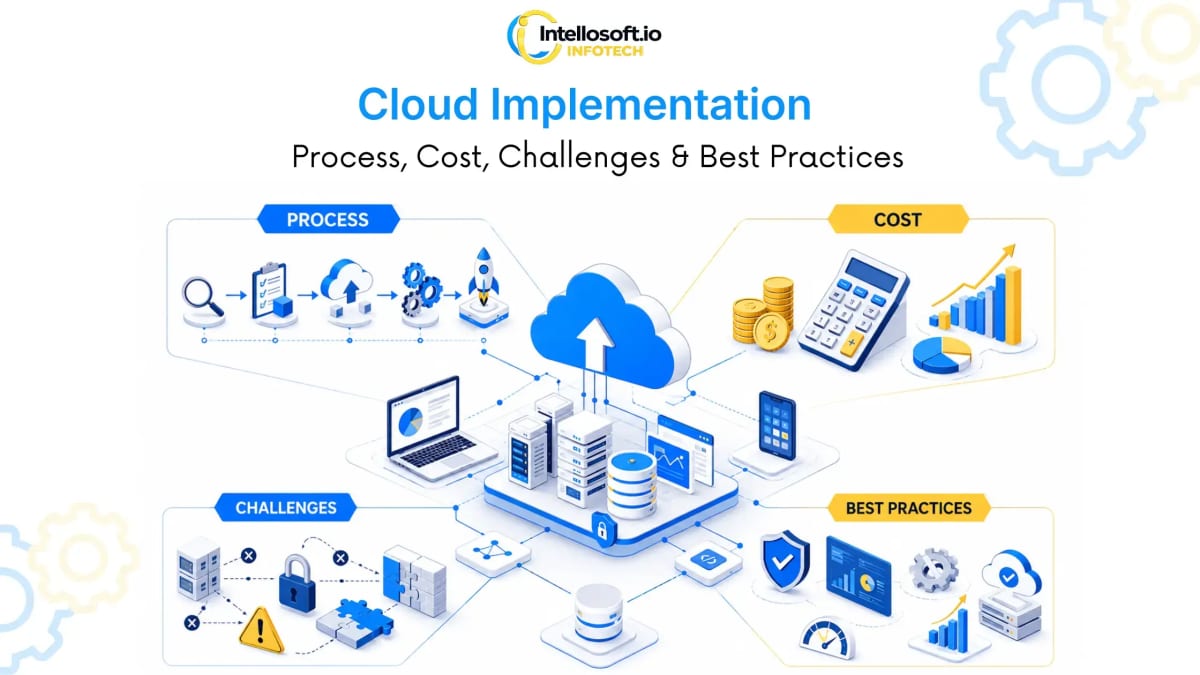
Introduction
The growth of the global cloud market reflects a decisive enterprise shift. Gartner forecasts that public cloud spending in India will reach $17.5 billion in 2026, representing a 28.1% growth from 2025. Infrastructure-as-a-Service (IaaS) is expected to grow by 40% during the year, driven in large part by accelerating demand for AI-ready infrastructure.
However, simply moving workloads to AWS, Microsoft Azure, or Google Cloud does not automatically make an organization more scalable, resilient, or cost-efficient.
⚠️ Risks of Poorly Planned Cloud Implementation:
A successful implementation requires much more than provisioning cloud virtual machines. It demands holistic cloud architecture, robust infrastructure setup, secure data migration, automated CI/CD pipelines, proactive monitoring, elastic scalability, and continuous cost governance.
This comprehensive guide explores the complete cloud implementation process, key cost drivers, common adoption pitfalls, and actionable best practices across AWS, Microsoft Azure, and Google Cloud Platform.
What Is Cloud Implementation and How Does It Work?
Cloud implementation is the end-to-end technical process of designing, deploying, configuring, migrating, securing, and managing applications, databases, and infrastructure within a public, private, hybrid, or multi-cloud environment.
Depending on organizational maturity and product roadmaps, a cloud implementation engagement can involve:
Standard Cloud Implementation Lifecycle Flow:
For businesses seeking expert guidance to scope and execute this transition, cloud consulting services provide technical readiness audits, target architecture roadmaps, migration planning, and hands-on implementation support.
Why Is Cloud Implementation Important for Businesses?
When engineered purposefully, a cloud environment directly empowers technical agility and high-level business expansion.
Improve Cloud Scalability
Elastic auto-scaling adjusts compute and memory dynamically based on real-time traffic spikes—essential for SaaS platforms, eCommerce portals, and rapid customer acquisition.
Accelerate Deployment Velocity
Integrated CI/CD pipelines and automated infrastructure eliminate manual server configuration, allowing engineering squads to deploy features multiple times per day.
Modernize IT Infrastructure
Replace fragile legacy hardware with managed databases, serverless functions, container runtimes (Kubernetes/Docker), and unified cloud storage.
High Resilience & Disaster Recovery
Multi-region availability zones, automated snapshots, and geo-redundant failover architectures protect against outages and data loss.
🤖 Support AI & Modern High-Throughput Workloads
AI adoption is now the single largest accelerator of cloud investment. Gartner highlights AI-ready infrastructure, scalable GPU clusters, and modern data pipelines as primary catalysts powering 2026 cloud growth.
Cloud Implementation Process: 10 Steps for Successful Adoption
A structured implementation framework mitigates downtime risks, ensures regulatory compliance, and builds an infrastructure foundation built to scale.
Assess IT Infrastructure Before Implementation
Start with a deep-dive inventory of your current environment: servers, databases, third-party APIs, networking topology, storage volumes, security policies, traffic patterns, and existing hosting expenditures.
AWS migration frameworks recommend establishing an early readiness score and Total Cost of Ownership (TCO) baseline to classify which workloads should be migrated, re-architected, retained, or retired.
Define a Measurable Cloud Strategy & Implementation Plan
Rather than setting vague goals like "moving everything to the cloud," align engineering milestones with measurable business objectives: 99.99% availability, sub-50ms latency for global users, 40% reduction in deployment lead times, or compliance with SOC 2 / HIPAA.
Choose the Right Cloud Architecture Model
Evaluate whether your workloads belong in Public Cloud (AWS, Azure, GCP), Private Cloud (dedicated single-tenant environments), Hybrid Cloud (connecting on-prem data centers with public clouds), or Multi-Cloud (leveraging specialized services across multiple providers).
Select the Target Cloud Platform (AWS vs Azure vs GCP)
Match your existing tech stack, internal developer skills, vendor discounts, and data compliance mandates to the optimal hyperscaler platform.
Design Scalable & Secure Cloud Infrastructure
Establish production-ready landing zones including Virtual Private Clouds (VPCs), subnets, application load balancers, container registries, managed databases, IAM policies, logging pipelines, and auto-scaling groups.
Our specialized cloud infrastructure services implement enterprise-grade AWS Well-Architected frameworks and Azure CAF standards.
Plan & Execute the Cloud Migration Strategy
Adopt proven migration pathways (Rehost, Replatform, Refactor) paired with real-time data replication to minimize or completely eliminate system downtime.
Explore how our cloud migration services handle complex database cutovers, zero-downtime synchronization, and rollback protocols.
Build In Zero-Trust Cloud Security
Enforce principle-of-least-privilege IAM roles, multi-factor authentication (MFA), end-to-end data encryption (at rest and in transit via TLS 1.3), automated secrets management, and proactive vulnerability scanning.
Automate with Infrastructure as Code (IaC) & CI/CD
Define all cloud assets using Terraform, Pulumi, or AWS CloudFormation. IaC ensures environments are version-controlled, testable, and instantly reproducible across dev, staging, and production.
Rigorously Test Before Production Cutover
Execute load tests, penetration audits, database failover simulations, backup recovery verifications, and latency benchmarks to guarantee system stability under peak traffic conditions.
Continuous Monitoring & Performance Optimization
Post-launch operations require 24/7 observability with Prometheus, Grafana, Datadog, or CloudWatch to detect bottlenecks, rightsize underutilized instances, and optimize ongoing monthly cloud spend.
AWS vs Azure vs Google Cloud: Choosing the Right Cloud Platform
The three major hyperscalers offer rich ecosystems of infrastructure and managed services, but each brings distinct architectural strengths:
| Platform | Core Strengths | Best-Fit Workloads | Adoption Framework |
|---|---|---|---|
| Amazon Web Services (AWS) | Broadest service catalog, market maturity, global availability, serverless (Lambda), ECS/EKS | SaaS platforms, cloud-native startups, high-volume microservices, global eCommerce | AWS Well-Architected Framework |
| Microsoft Azure | Native integration with Active Directory, Windows Server, SQL Server, Microsoft 365, OpenAI Service | Enterprise IT, hybrid corporate infrastructure, Microsoft-centric technology stacks | Microsoft Cloud Adoption Framework (CAF) |
| Google Cloud (GCP) | Industry-leading Kubernetes (GKE), BigQuery analytics, Vertex AI, advanced machine learning tooling | Data-intensive applications, generative AI pipelines, containerized multi-cloud setups | GCP Migration Center Framework |
Plan a Cloud Migration Strategy (The 5 Rs)
Every application in your portfolio requires a tailored migration pathway based on technical debt, criticality, and budget:
Rehost (Lift & Shift)
Move workloads to cloud VMs with minimal code changes. Fast to execute, but doesn't fully exploit cloud elasticity.
Replatform (Lift & Reshape)
Upgrade underlying components (e.g. switching self-hosted databases to Amazon RDS or Azure SQL) without altering core logic.
Refactor (Re-architect)
Redesign legacy monoliths into cloud-native microservices, serverless lambdas, and event-driven architectures for maximum scale.
Retire
Decommission redundant, obsolete, or underused systems to eliminate licensing costs and reduce surface attack vectors.
Retain
Keep specific legacy or highly compliant workloads on-premise when immediate migration offers low ROI.
How Much Does Cloud Implementation Cost?
There is no one-size-fits-all price tag for cloud implementation. The total investment depends on infrastructure scale, number of environments, compliance requirements, database volume, and customization.
🚀 Initial Implementation (One-Time)
- • IT infrastructure readiness audit
- • Cloud architecture & landing zone design
- • Infrastructure as Code (Terraform) scripts
- • Application & database migration execution
- • Security hardening & penetration testing
- • CI/CD deployment pipeline setup
⚙️ Ongoing Cloud Costs (Recurring)
- • Cloud compute (EC2, Fargate, AKS)
- • Managed databases (RDS, DynamoDB, CosmosDB)
- • Cloud storage & backup snapshots
- • Network egress & CDN bandwidth
- • Monitoring, SIEM & security tools
- • Managed operations & 24/7 support
Evaluating the Total Cost of Ownership (TCO)—factoring in reduced hardware upkeep, lower engineering downtime, and automated deployments—gives a true picture of long-term return on investment.
Cloud Cost Optimization: How to Prevent Cloud Spend Waste
While cloud adoption creates immense agility, unmonitored resources can quickly inflate monthly bills.
For organizations aiming to systematically optimize monthly bills, our cloud cost and performance services uncover hidden resource waste and maximize infrastructure ROI.
Common Cloud Implementation Challenges and How to Overcome Them
❗ Unexpected Infrastructure Bill Shock
Cause: Unused sandbox environments, lack of budget alerts, unmonitored egress traffic.
Solution: Enforce strict resource tagging, automated budget alerts, and scheduled instance power-downs.
❗ Unplanned Migration Downtime
Cause: Undocumented network dependencies, slow database transfers, un-rehearsed DNS cutovers.
Solution: Execute pilot runs, utilize continuous data replication tools, and design automated rollback procedures.
❗ Security Misconfigurations
Cause: Overly permissive IAM policies, publicly accessible S3 buckets, hardcoded credentials.
Solution: Implement automated policy-as-code scanners, centralized secrets vaults, and multi-factor authentication.
❗ In-House Cloud Skills Gap
Cause: Modern cloud stacks contain hundreds of specialized tools and complex architectures.
Solution: Partner with expert cloud consulting services to architect and bootstrap infrastructure while upskilling internal teams.
Cloud Implementation Best Practices for Secure & Scalable Adoption
✓ Start With Business Outcomes
Anchor architecture decisions to core KPIs (latency, throughput, cost) rather than adopting tech for tech's sake.
✓ Build Secure Landing Zones
Configure multi-account isolation, network firewalls, and unified IAM before migrating production data.
✓ Standardize on IaC
Never configure production manually via cloud consoles. Use Terraform or Pulumi for reproducible deployments.
✓ Automate CI/CD Pipelines
Automate build, testing, linting, container packaging, and progressive canary deployments.
✓ Embed Security From Day Zero
Incorporate DevSecOps security checks, image vulnerability scanning, and automated credential rotation.
✓ Test Disaster Recovery
Don't rely solely on automated backups. Periodically test complete cluster and database failover restores.
✓ Maintain Live Architecture Docs
Keep updated system topology diagrams, incident playbooks, and service ownership manifests.
✓ Continuous Post-Launch Audits
Treat cloud infrastructure as an evolving system with recurring quarterly architecture and FinOps reviews.
When Should Businesses Use Managed Cloud Services?
Maintaining 24/7 cloud infrastructure uptime, zero-day patch management, and continuous optimization requires substantial operational overhead.
Businesses choose managed cloud partners when they want dedicated cloud expertise without the friction and expense of recruiting a full-time DevOps team.
How Managed Cloud Services Accelerate Growth:
Intellosoft delivers end-to-end managed cloud services tailored for high-growth startups, SMEs, and digital enterprises.
Frequently Asked Questions
Conclusion: Building a Scalable Cloud Strategy
Cloud implementation is far more than simply moving servers from on-premise racks into AWS, Azure, or GCP. A high-performing cloud implementation connects robust architecture, streamlined migration, zero-trust security, DevOps automation, and FinOps cost governance directly to business ROI.
With India's public cloud spending surging toward $17.5B in 2026 and AI infrastructure expanding rapidly, organizations that establish a solid cloud foundation today will outpace competitors in scalability, reliability, and innovation.
Ready to Build or Modernize Your Cloud Infrastructure?
Whether you are planning a greenfield SaaS launch, migrating mission-critical enterprise workloads, or optimizing existing cloud costs, Intellosoft's certified cloud architects can help.