
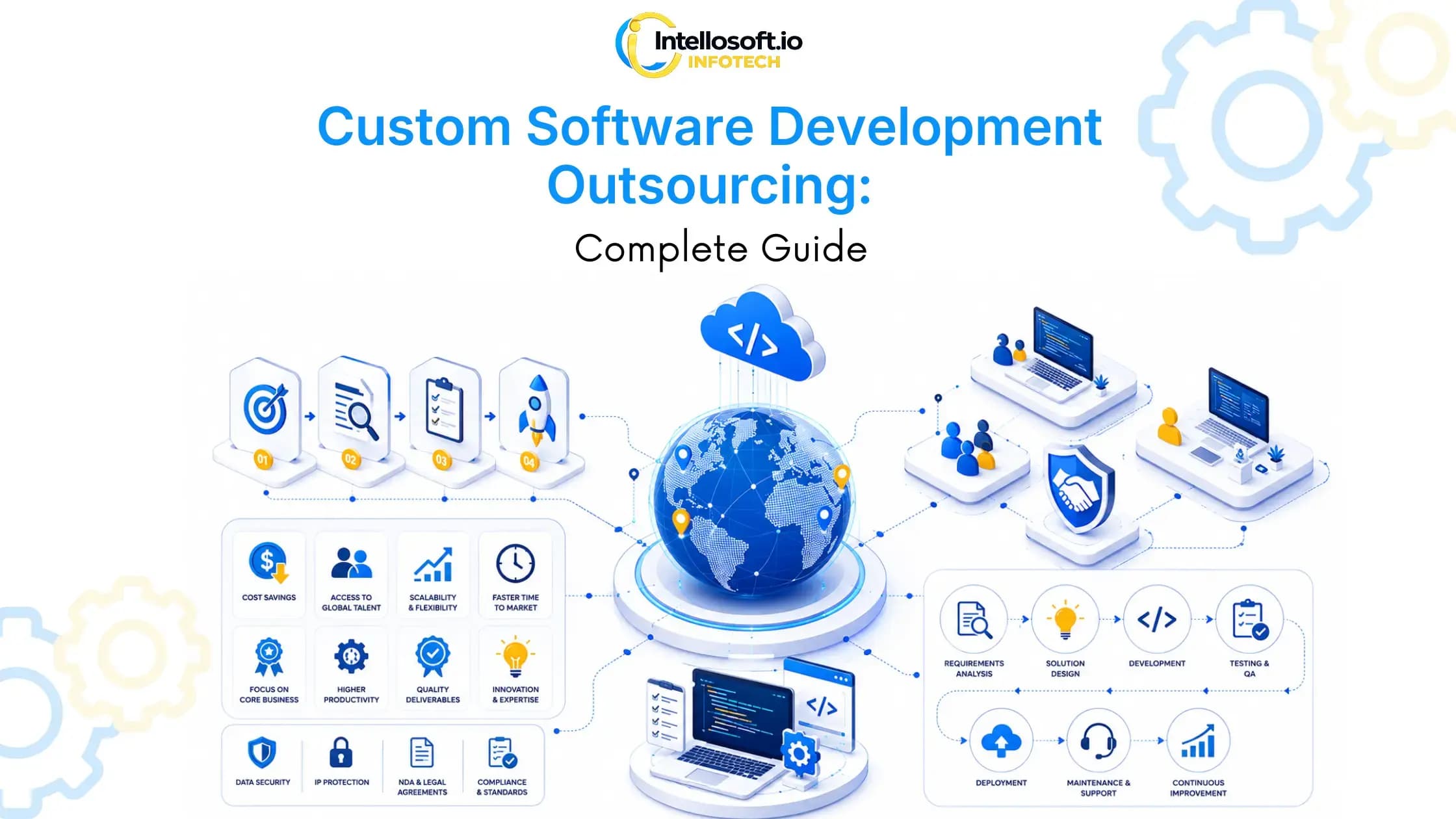
Outsourcing custom software development can help businesses access specialized engineering talent, expand development capacity, and build products without creating a large internal engineering team.
But there is one concern that often comes before the first contract is signed:
"If an external team builds our software, how do we make sure we don't lose control of the product?"
That concern is legitimate.
When software development is outsourced without clear ownership, governance, security controls, and communication processes, businesses can face problems involving source-code access, intellectual property, technical debt, vendor dependency, security, scope changes, and unexpected costs.
However, outsourcing does not mean giving away control.
The right outsourcing model allows your business to retain ownership of the product and key decisions while an external engineering team handles part or all of the technical execution.
The market is also becoming increasingly important. Mordor Intelligence estimates the global software development outsourcing market at $618.38 billion in 2026, with a projected 9.6% CAGR from 2026 to 2031. Its analysis estimates that offshore delivery represented 51.85% of the market in 2025.
The important takeaway isn't simply that the market is growing.
It is that businesses increasingly use external development teams to access specialized capabilities, increase flexibility, and support digital product development.
So, how do you outsource software development without losing control?
Let's look at the practical framework.
What Is Custom Software Development Outsourcing?
Custom software development outsourcing means hiring an external software development company or engineering team to design, develop, test, deploy, or maintain software according to your business requirements.
Depending on the engagement, an outsourced software development team may provide:
- Product discovery and requirements analysis
- UI/UX design
- Software architecture
- Frontend and backend development
- Mobile application development
- API development and integration
- Cloud infrastructure
- Quality assurance and testing
- DevOps and CI/CD
- Security implementation
- Software maintenance and support
The important distinction is between ownership and execution.
Your company can retain:
- Product ownership
- Business priorities
- Intellectual property
- Source-code ownership
- Strategic decisions
- Customer relationships
- Product roadmap
while the development partner provides the engineering capacity required to execute the roadmap.
Outsourcing execution does not have to mean outsourcing ownership.
Why Are Businesses Outsourcing Software Development?
Cost is still one consideration, but modern software outsourcing is increasingly about access to expertise, scalability, flexibility, and speed.
A 2026 DesignRush analysis reports that 78% of companies surveyed had engaged an outsourcing provider within the previous six months. It also reports that developer hourly rates declined by 9%-16% across several key regions, although actual pricing varies significantly by geography, experience, technology, and project requirements.
Mordor Intelligence also reports that large enterprises represented 70.95% of software development outsourcing revenue in 2025, while SMEs are forecast to grow faster, with an estimated 11.25% CAGR through 2031.
This suggests that outsourcing is no longer simply a "hire developers for less" strategy.
Businesses may outsource when they:
- Need specialized engineering skills
- Need additional development capacity
- Want to accelerate product development
- Need to modernize legacy software — see our IT consulting services
- Need cloud or DevOps expertise
- Need AI or machine learning capabilities
- Want to build an MVP
- Need a dedicated development team
- Want ongoing product development without expanding internal headcount
The Biggest Outsourcing Risk Is Losing Visibility
One of the biggest mistakes businesses make is assuming that outsourcing itself creates the risk.
In reality, many outsourcing problems are governance problems.
IBM identifies several risks associated with third-party outsourcing, including communication barriers, vendor dependency, security concerns, compliance challenges, and unforeseen costs.
When outsourcing custom software development, your organization should maintain visibility into at least these areas:
- Product roadmap
- Source-code ownership
- Intellectual property
- Data access
- Architecture
- Security
- Development standards
- Project progress
- Budget and scope
- Deployment infrastructure
If these areas are unclear, you can become dependent on the vendor even if the technical work itself is good.
The solution isn't necessarily to avoid outsourcing.
The solution is to structure the outsourcing relationship correctly.
8 Ways to Outsource Custom Software Development Without Losing Control
1. Keep Control of the Product Roadmap
An outsourcing partner can recommend technical solutions, but your business should retain control over product priorities.
Your roadmap should define:
- Business objectives
- Target users
- Feature priorities
- Release milestones
- Product requirements
- Success metrics
- Future development priorities
A good development partner should challenge assumptions when necessary and explain technical trade-offs.
But the final decision about what the product should accomplish should remain with the product owner.
Create shared project visibility
Use a project-management or collaboration platform where stakeholders can see:
- Product backlog
- Sprint objectives
- Completed work
- Upcoming work
- Blockers
- Decisions
- Release status
This prevents the outsourced team from becoming a black box.
2. Make Source-Code Ownership Explicit
One of the first questions to answer before signing a software development outsourcing agreement is:
Who owns the source code?
Don't leave this to assumptions.
Your agreement should clearly address:
- Source-code ownership
- Intellectual property rights
- Repository access
- Third-party components
- Open-source licenses
- Documentation ownership
- Deployment credentials
- Design files
- Database structures
- Technical documentation
Where practical, your organization should have appropriate access to the source-code repository throughout the engagement rather than receiving the complete codebase only at the end.
That reduces vendor dependency and makes future maintenance or transition easier.
3. Protect Intellectual Property
If you are outsourcing development for a proprietary product, intellectual property protection should be addressed before development begins.
Your agreement should define:
- Confidentiality
- IP ownership
- Ownership of deliverables
- Permitted data access
- Restrictions on reuse
- Data handling
- Termination obligations
- Data deletion or return
An NDA can provide confidentiality protection, but an NDA is not a complete software ownership agreement.
The development contract should clearly define who owns the code, designs, documentation, databases, and other project deliverables.
For highly sensitive projects, businesses should also consider legal review of their agreements.
4. Control Vendor Access to Your Systems
Security becomes particularly important when working with an offshore software development team or any external engineering partner.
Use the principle of least privilege:
Give each person only the access required to perform their role.
For example:
| Environment | Typical access |
|---|---|
| Development | Developer access |
| Staging | Development + QA access |
| Production | Restricted operational access |
A developer who needs access to a development environment does not automatically need unrestricted production access.
This becomes increasingly important because modern applications depend on much more than application code.
They may include:
- Open-source packages
- APIs
- Cloud services
- Container images
- Infrastructure-as-code
- CI/CD pipelines
IBM notes that modern software environments contain multiple interconnected components, increasing the difficulty of maintaining visibility across application and infrastructure risks.
5. Measure Outcomes, Not Just Developer Hours
Another common outsourcing mistake is measuring activity rather than results.
Weak metric: "The development team worked 160 hours."
That tells you how much time was spent.
It doesn't tell you what was achieved.
Better metrics include:
- Features completed
- Sprint commitments delivered
- Defect rate
- Release frequency
- Lead time
- Test coverage
- Performance benchmarks
- Security findings
- Milestone completion
- Acceptance criteria
Your weekly or biweekly project review should answer four questions:
- What was delivered?
- What is blocked?
- What happens next?
- What decisions are required from the client?
This creates accountability without micromanaging developers.
6. Choose the Right Software Outsourcing Model
Different projects require different engagement models.
| Engagement Model | Best For | Flexibility | Budget Predictability | Client Control |
|---|---|---|---|---|
| Fixed Price | Clearly defined scope | Low-Medium | High | High at scope level |
| Dedicated Team | Long-term product development | High | Medium | High |
| Time & Material | Evolving requirements | Very High | Lower | High |
Fixed-price development
A fixed-price agreement works best when requirements, deliverables, and acceptance criteria are clearly defined.
The major limitation is flexibility. Significant changes can require renegotiation or change requests.
Dedicated development team
A dedicated team works as an extension of your internal organization.
This can be useful when the product will evolve continuously and you need consistent engineering capacity.
Time and material
Time-and-material engagements provide flexibility when requirements are uncertain or expected to change.
However, they require stronger budget tracking and project governance.
There is no universally best model.
The right choice depends on how clearly you can define the scope and how frequently the requirements are expected to change.
7. Compare Software Outsourcing Companies by Total Value
Don't choose a custom software outsourcing company based solely on hourly rates.
Consider this simplified example:
| Factor | Vendor A | Vendor B |
|---|---|---|
| Hourly rate | $30 | $60 |
| Estimated hours | 3,000 | 1,800 |
| Estimated development cost | $90,000 | $108,000 |
| Rework risk | Higher | Lower |
| Project management | Limited | Included |
| QA | Separate | Included |
| Documentation | Limited | Included |
Vendor A has the lower hourly rate.
But Vendor B has a higher hourly rate and a lower estimated number of hours.
This illustrates why hourly rate != total project cost.
A broader evaluation should consider:
Total Cost of Ownership = Development + Management + Rework + Infrastructure + Maintenance + Transition
The figures above are a hypothetical comparison, not an industry benchmark.
When requesting proposals, ask each vendor to explain:
- Estimated effort
- Team composition
- Deliverables
- Assumptions
- Dependencies
- QA approach
- Project management
- Infrastructure costs
- Maintenance
- Change-request process
That makes proposals much easier to compare.
8. Create a Knowledge-Transfer and Exit Plan
Vendor dependency becomes a serious problem when nobody knows how the software could be maintained without the original development team.
You don't need to plan for failure.
You need to plan for business continuity.
Maintain:
- Source-code repositories
- Architecture documentation
- API documentation
- Deployment documentation
- Database documentation
- Environment information
- Access-management records
- Testing documentation
- Product requirements
- Technical decision records
The goal is simple:
Your business should remain capable of operating and maintaining the product even if the development relationship changes.
Offshore vs Onshore Software Development Outsourcing
Businesses often compare offshore, nearshore, and onshore development.
| Factor | Onshore | Nearshore | Offshore |
|---|---|---|---|
| Geographic proximity | High | Medium | Lower |
| Time-zone overlap | Usually high | Often high | Varies |
| Talent pool | Depends on market | Expanded | Often broad |
| Cost potential | Usually higher | Medium | Often lower |
| Communication | Usually simpler | Manageable | Requires stronger processes |
| Scalability | Medium | High | High |
Offshore development does not automatically mean lower quality.
Likewise, onshore development does not automatically guarantee better quality.
The outcome depends on:
- Engineering capability
- Communication
- Technical standards
- Security
- QA
- Project governance
- Documentation
- Product management
Mordor Intelligence estimates offshore delivery represented 51.85% of the software development outsourcing market in 2025, demonstrating that offshore delivery remains a major part of the market.
How Much Does Software Development Outsourcing Cost?
There is no universal price for software development outsourcing.
The cost can vary based on:
- Development location
- Developer experience
- Technology stack
- Project complexity
- Team size
- Number of features
- Integrations
- Security requirements
- Testing requirements
- Cloud infrastructure
- Maintenance requirements
Published market pricing also varies considerably by source and region.
For example, DesignRush's 2026 analysis cites developer-rate changes across several regions, including declines of approximately 9%-16% in some markets. It also provides regional hourly-rate ranges that vary substantially by developer seniority and location.
Therefore, using one online hourly-rate figure to calculate your entire project budget can be misleading.
A more reliable approach is:
Define scope - Estimate effort - Select engagement model - Calculate development cost - Add contingency - Plan maintenance
For a complex project, the most useful first step is usually a structured discovery and requirements exercise rather than requesting a price based on a one-paragraph project description.
Questions to Ask Before Choosing a Custom Software Outsourcing Company
Before signing a contract, ask these questions.
1. Who owns the source code?
Make sure ownership is explicitly defined.
2. Where is the source code stored?
Ask whether your organization has repository access.
3. How will project progress be reported?
Understand the reporting cadence, tools, and metrics.
4. Who makes technical decisions?
Define responsibilities for architecture, technology, and product decisions.
5. How is security handled?
Ask about access controls, secure development, testing, backups, and production access.
6. What happens when requirements change?
Understand the change-management process.
7. What happens after launch?
Clarify maintenance, support, documentation, and knowledge transfer.
8. What happens if we change development partners?
Ask how the team will support transition and handover.
These questions can reveal more about an outsourcing partner than a long list of technologies on a website.
Common Software Development Outsourcing Mistakes
Choosing the Cheapest Vendor
A lower hourly rate doesn't necessarily mean a lower total cost.
Evaluate the complete delivery model.
Starting Development Without Discovery
Poorly defined requirements can create rework, scope disputes, and delays.
Keeping Requirements Only in Conversations
Important requirements should be documented and connected to acceptance criteria.
Giving Unrestricted Production Access
Production access should be controlled according to roles and responsibilities.
Ignoring Documentation
Documentation is essential for long-term maintainability and transition.
Measuring Hours Instead of Outcomes
Hours are an input.
Delivered functionality, quality, and business outcomes are what matter.
Treating Outsourcing as a Complete Handover
The strongest outsourcing relationships are collaborative.
The business retains product ownership while the development partner provides engineering capability.
When Should You Outsource Software Development?
Software development outsourcing may make sense when your organization:
- Needs specialized engineering skills
- Has limited internal development capacity
- Wants to accelerate product development
- Needs to build an MVP
- Is modernizing legacy software
- Requires cloud or DevOps expertise
- Needs additional engineering capacity
- Wants a dedicated development team
- Needs ongoing product development
However, outsourcing isn't automatically the best choice.
If a capability is central to your competitive advantage and requires constant internal knowledge, maintaining an internal team may be more appropriate.
A hybrid model can often provide a middle ground:
- Internal team: Product strategy + business ownership + key decisions
- External team: Additional engineering capacity + specialized implementation
Software Development Outsourcing Checklist
Before signing an outsourcing agreement, make sure you can answer:
- What business problem are we solving?
- What is included in the initial scope?
- Who owns the product roadmap?
- Who owns the source code?
- How is intellectual property protected?
- Where is the repository hosted?
- Who can access production?
- What security requirements apply?
- What are the acceptance criteria?
- How will progress be measured?
- How will scope changes be handled?
- Which engagement model will we use?
- What documentation will be delivered?
- What happens after launch?
- How will knowledge be transferred?
If several of these questions don't have clear answers, the project may not be ready to enter development.
Final Takeaway: How to Outsource Software Development Successfully
Successful outsourcing isn't about giving control to an external company.
It's about separating ownership from execution.
Your business should retain control over:
Product - IP - Source Code - Data - Security - Roadmap - Key Decisions
while the development partner provides:
Engineering - Design - Testing - DevOps - Specialized Expertise - Delivery Capacity
Before selecting a partner, evaluate the complete relationship:
Scope - Team - Process - Security - Ownership - Communication - Quality - Cost - Long-Term Support
When these elements are clearly defined, outsourced software development can become an extension of your engineering capability rather than a dependency.
If your business is evaluating an external development team, start with the problem you need to solve, the capabilities you need, and the level of control you want to retain.
Intellosoft can support businesses with custom software development, enterprise applications, web application development, mobile app development, API integrations, cloud services, AI development, and DevOps capabilities.
Ready to explore custom software development outsourcing?
Start with the problem you need to solve, the capabilities you need, and the level of control you want to retain.